The Nature of Human Perception
Colors are the stimulants of perception. Like chemical messages received by the eye, they are carried through the optic nerve and delivered to the brain, the hub of judgment. Here, the brain’s interpretation of what the eye has seen may occur in exceptional ways.
„In human vision, there is an independent sense of illumination. Exploitation of this sense gives promise of new modes of colour expression for the future“. – David Katz
Color and Science merge
With books such as “The Principles of Harmony and Contrast of Colors“ (Chevreul, 1839) and new principles drawn from physiological optics (fostered by Helmholtz and Rood) the science of colour applied to art inspired the fundamentals of impressionism.
Fundamentals of Impressionism
°Small visible brushstrokes
°Open composition
°Portrayel of light and it’s changing qualities
°Ordinary subject matter
°Movement
°Unusual visual angles
Impressionists
Inspired by colour theory, impressionists portray their impression of a subject rather than recreating actual details of reality. They shun outline and specifics to create art in a freer form that reflected human perception. They achieved this through a variety of techniques.
Techniques of the Impressionists
Impasto
Application of thick paint layers which eliminates distinctive lines reflecting human perception, rather than a precise depiction of reality.
Broken Colour
Using the principle that colours mix optically, light layers of colour are painted with the uppermost coats broken to reveal the colour underneath by using:
°Hatching (short linear strokes)
°Cross-hatching (when linear strokes cross)
°Making patterned marks that vary in density
such as; dots (stippling), dry brushstrokes, and sgraffito.
*Thus capturing the effects of light and the form of the object rather than details.
Diffusion and Mixing
Diffusion is a technique which replaces hard lines in paintings by laying colours
side-by-side which are mixed optically. Instead of Black, complimentary
colours are combined to achieve dark values. Instead of glazing, the paint is opaque.
Wet Paint
wet into wet paint is used to diffuse hard lines and mingle colour in order to achieve a three-dimensional effect. This is also used in impasto.
Effets De Soir and En Plein Air
Painting outdoors and often in the evening when the effects of light and shadows were
more dramatic
Post-Impressionism
Emerged from the opticality of the impressionism movement with new uses of color, pattern, form, and line. This change included such artist’s as Vincent Van Gogh, Paul Gauguin, Georges Seurat, and Henri de Toulouse-Lautrec.
Neo-Impressionism
Brought a new approach to the Impressionists’ interests in light and colour, and created new methods of laying paint using dashes and dots. Its followers focused on modern urban scenes as well as landscapes and seascapes.
The movement, founded by Georges Seurat in the 1880s, included others such as Henri Matisse, Paul Signac, and Camille Pissarro.
Pointillism
A method in which paint is applied as small points or daubs of colour. Based on the laws of colour theory, pointillism depends on the viewer’s eye to mix the dots into the forms, colours, and values of the full scene.
The Pointillists
*Both pointillist artists used the principle of applying colour, known as „melange Optique“ (optical mixture), which is painting dots of pure colour separately on the canvas and allowing the eye to mix them.
Seurat
Was fascinated by the science of colour a well as form and expression. He believed the direction of lines in a painting could depict warmth or coolness. He practised the discovery that complementary colours could mix optically creating much more vivid results, than mixing them on the palette.
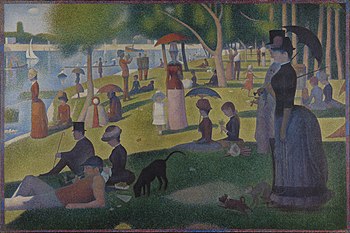
In the painting above, Seurat uses tiny dots of colour to impress the viewer with a warm, sunny day. With different densities between the dots of colour, he creates a range of values of light and luminosity. Dots of complementary colours allow a natural diffusion between objects, where there would be hard lines in a typical sketch.
Signac
worked with various mediums producing paintings in tiny dots,
and never relied on lines to create form.
“…the separated elements will be reconstituted into brilliantly coloured lights.” -Signac
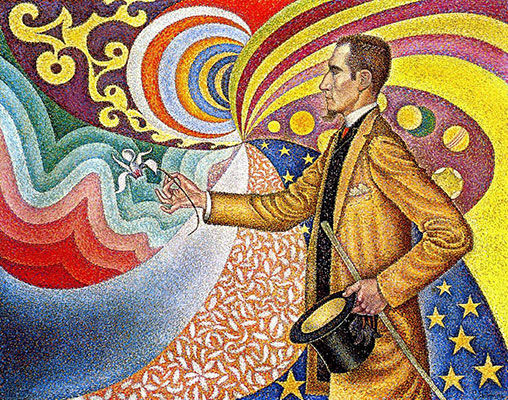
Here Signac uses dots of many colours to create the impression of a single colour through optical mixing.
My Study in Pointillism
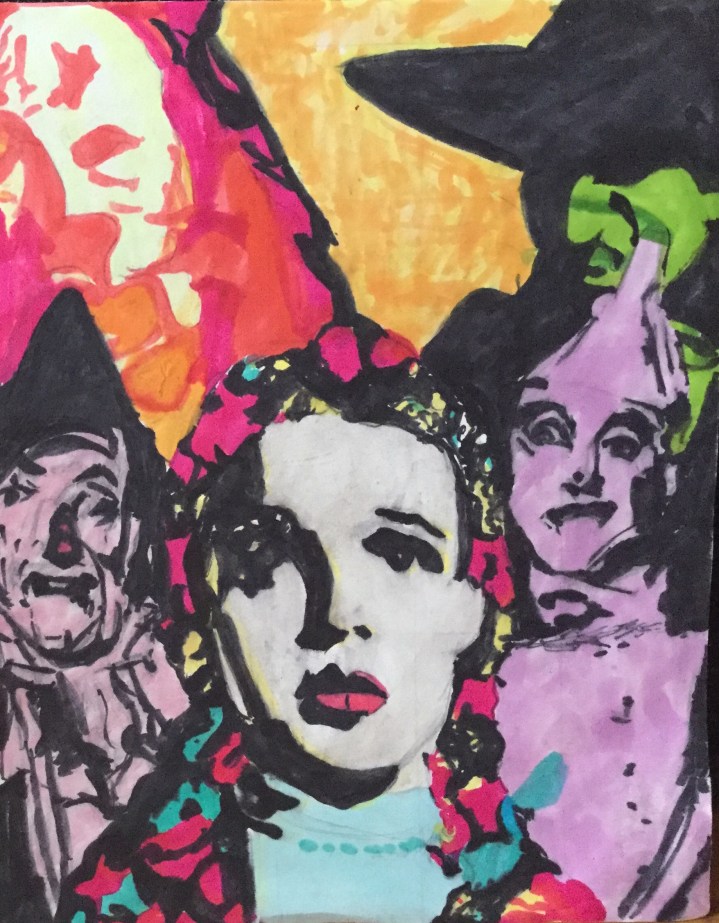
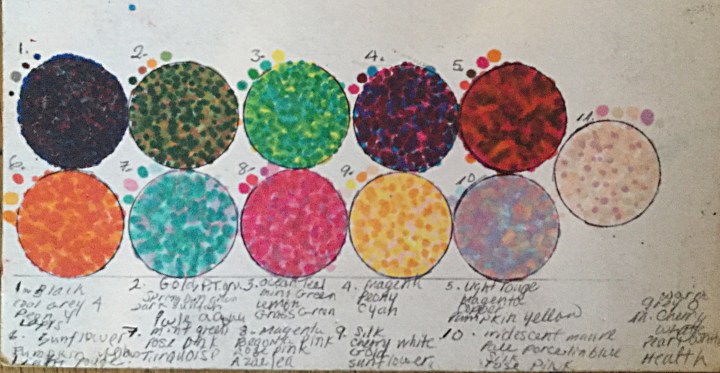
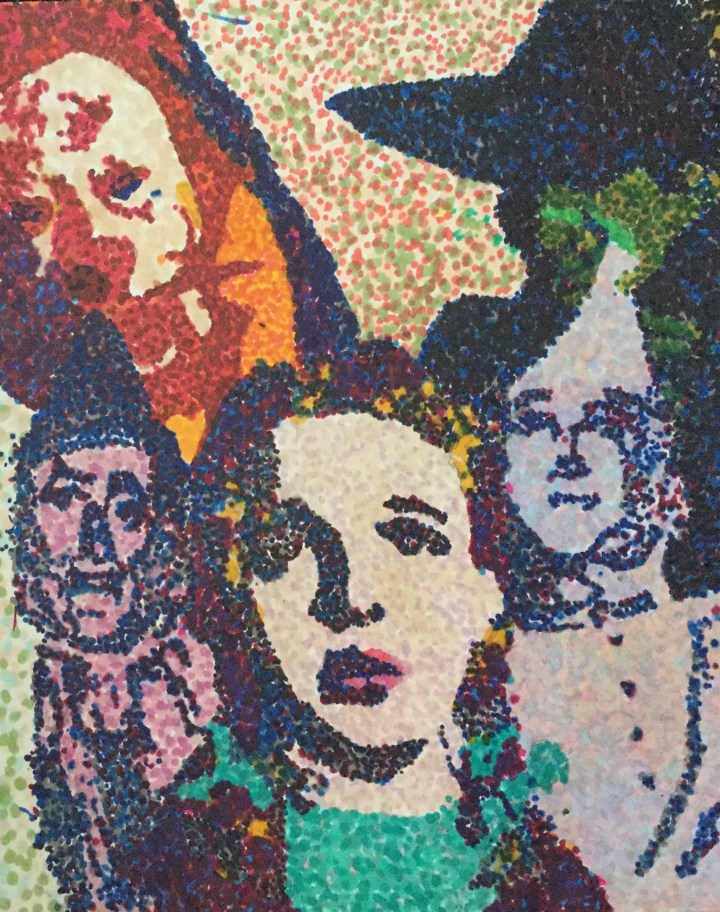
Second sketch using points of colour and eliminating lines
Op Art Movement (or Optical Art Movement)
Included paintings or sculptures which seem to grow and pulsate through the use of optical effects. The Leading figures of this movement, Bridget Riley and Victor Vasarely, both used patterns and colours in their paintings to achieve a disorientating impact on the viewer.
Bridget Riley
In the 1960’s, this Op artist created geometric paintings of squares, ovals, stripes, and curves to stimulate both physical and psychological responses of the eye. She wanted the viewer to question the reality of what they were seeing. She produced paintings which appeared to be in motion. Her work inspired textile designs and psychedelic posters.

References
Anon, Bridget Riley Biography, Art, and Analysis of Works | The Art Story. The Art Story. Available at: http://www.theartstory.org/artist-riley-bridget-artworks.htm [Accessed November 27, 2017a].
Anon, How Impressionists Work, Ways in which Impressionists Paint. Available at: http://www.impressionism.org/pleine.htm [Accessed November 27, 2017b].
Anon, Impressionism Movement, Artists and Major Works | The Art Story. The Art Story. Available at: http://www.theartstory.org/movement-impressionism.htm [Accessed November 27, 2017c].
Birren, F., 1976. Color Perception in Art: Beyond the Eye into the Brain. Leonardo, 9(2), pp.105–110. Available at: http://www.jstor.org/stable/1573116.
Anon, 2012. THE TECHNIQUE. Impressionist Techniques. Available at: https://impressioniststech.wordpress.com/the-technique/ [Accessed November 27, 2017].
 Creative Arts