Dutch Still Life Paintings
17th-century Dutch painters strived to capture images as realistically and truthfully as possible. They served as record keepers of all the land, gardens, horticulture and everyday scenes that ordinary person perceived during the „Golden Age”. These artists were attentive to spatial relations, and lighting to achieve a three-dimensional effect on a two-dimensional surface.
Haarlem
Was a significant art centre in 17th century Holland. Many artists emigrated there either because of their Protestant beliefs or because of the poor economic climate of Flanders. Haarlem was flourishing in commercial prosperity and Dutch affluence. These economic improvements provoked the rise of a prosperous middle class. Most still lifes at this time (considered at the lower end of the hierarchy of Dutch realism painting) were representative and intended for the flourishing middle class, who intern purchased them. One Belgium artist, Peter Claesz (1597-1661) made his name as a renowned artist there.

In this still life and many others that came from Haarlem, the composition contains items that were once precious, but now easily attainable due to the growing wealth of this socio-economic class.
18th Century Still Lifes
people had grown tired of floral and food still life paintings and preferred to purchase instead porcelain, wallpaper, and wood carved furniture with those symbols. Paintings of actual figures became of more interest.
19th Century Still Lifes
In the 19th century, photography had was invented, and there was no longer desire to create photo-realistic looking paintings. Dutch Still Lifes were reinvigorated by the new techniques of the impressionist and post-impressionists. With the development of colour theory and scientific principals of optical perception; artists began to experiment with colour, shapes, tone and the way paint was applied to canvas. Paris became the new art centre for these less traditional painters. They began to create to create pieces which were beautiful in themselves – not because of what they meant. One artist, in particular, was responsible for raising Still life art to a respectable status; Paul Cézanne.
Here he uses a full range of complementary colours and visible brush strokes

Floral Still Life
My favourite floral still lifes from the 19th century Dutch Artists were by Vincent Van Gogh.
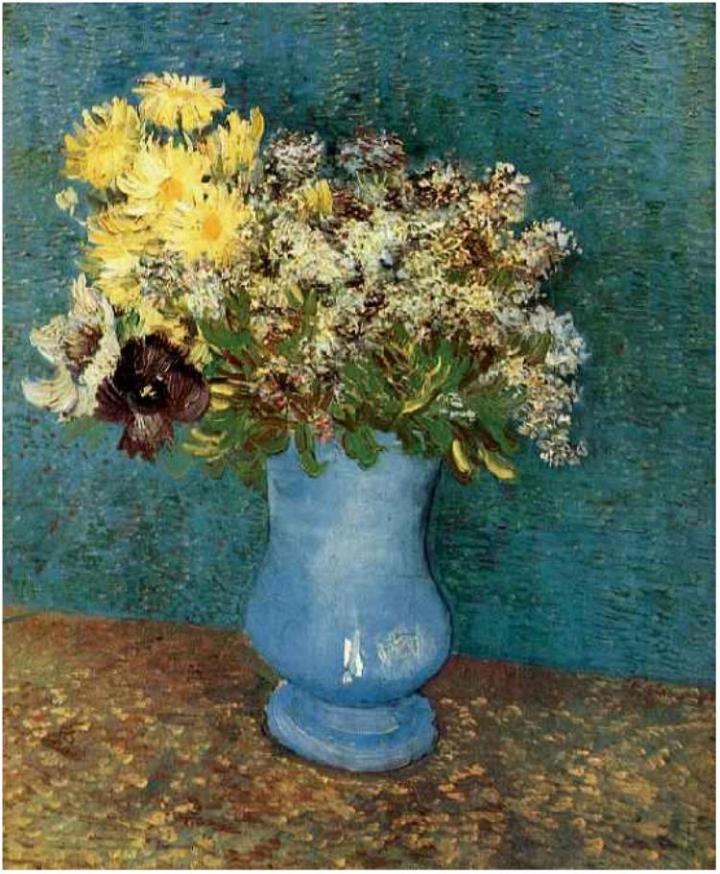
This piece by Van Gogh was created during a time when the artist had no money, and could no longer pay for models for his figure painting. Thus he began a series of colour studies in flower paintings. It was a turning point for him, as he moved away from his darker paintings and became interested in more colourful works of the Impressionists. He sought oppositions of blue with orange, red and green, yellow and violet. In 1887 he wrote, „I painted almost nothing but flowers to accustom myself to a colour other than grey, that’s to say pink, soft or bright green, light blue, violet, yellow, orange, fine red.” These paintings also reflected emotional transitions, as he went through bouts of mental illness and then regained a sense of clarity and optimism.
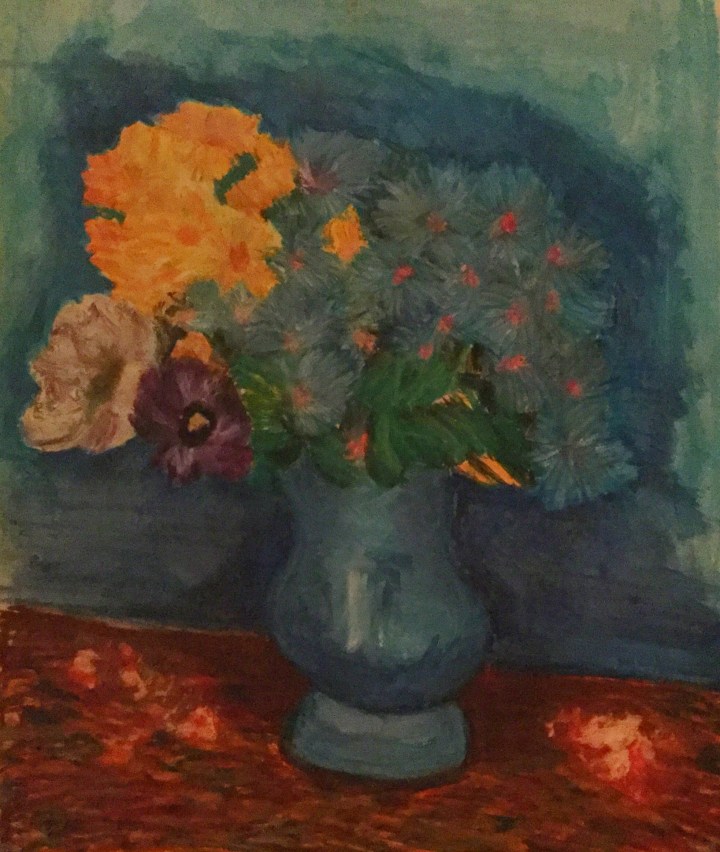
I am attracted by the contrast of colours (red against green) and warm and cool tones. It gives me the sense of hopefulness, the shades of yellow, gold, brown-red are uplifting. There seems to be one single lilac in the vase (also seen in other floral still lifes of Van Gogh). Later, during Van Gogh’s stay in an asylum, he painted an entire bush of lilacs. I wondered if the single lilac seen previously, foretold some mental calamity to come. Though the painting overall seems hopeful and uplifting, there the lilac presents a seed of darkness. I also admire the broken colour, small brush strokes, dashes, and dots that give the painting a lifelike texture. I created a study of this painting, trying to replicate the same colours and techniques with oil pastels. I researched both impressionism and divisionism painting techniques to gain a better understanding of how he achieved this. My results weren’t bad, though it was harder to layer colours in oil pastels than oil paints would have been, as the paper quickly became overloaded with pigment. In the future, I would like to attempt this again, with actual brush strokes.
If I repeat any impression style still lifes again with oil pastel or watercolour, I will outline the basic shapes in a dark tone, but begin blocking in the colours working from light to dark.
20th Century Still Life Development
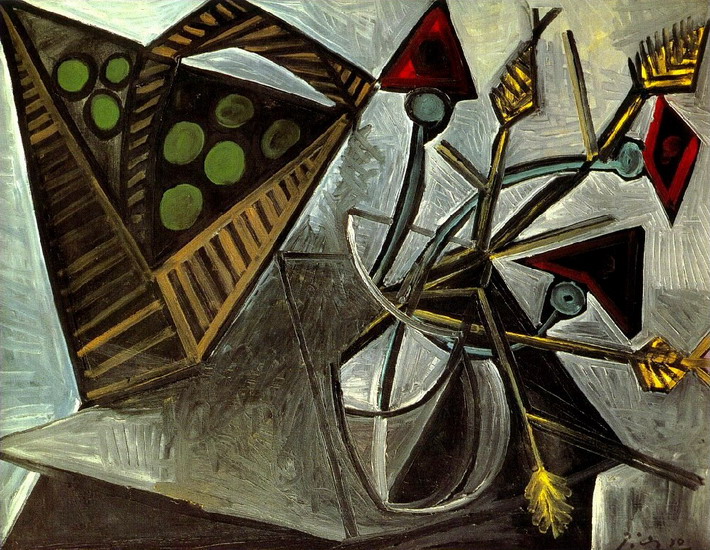
Along came Picasso and Baroque who invented „Cubism“, and once more still life gained interest. Perhaps they were trying to find a new way of expressing the same thing.
While there’s a lot to be gained from studying the great masters in regards to colour, form, tone and perspective; I am growing weary from still lifes of flowers, fruit and tableware – whether in dots, cubes, bubbles or realism. I look forward to studying later movements.
Present Day Still Life
Presents different subjects and new media forms in various styles such as Dada, Pop Art, and Conceptual Art.
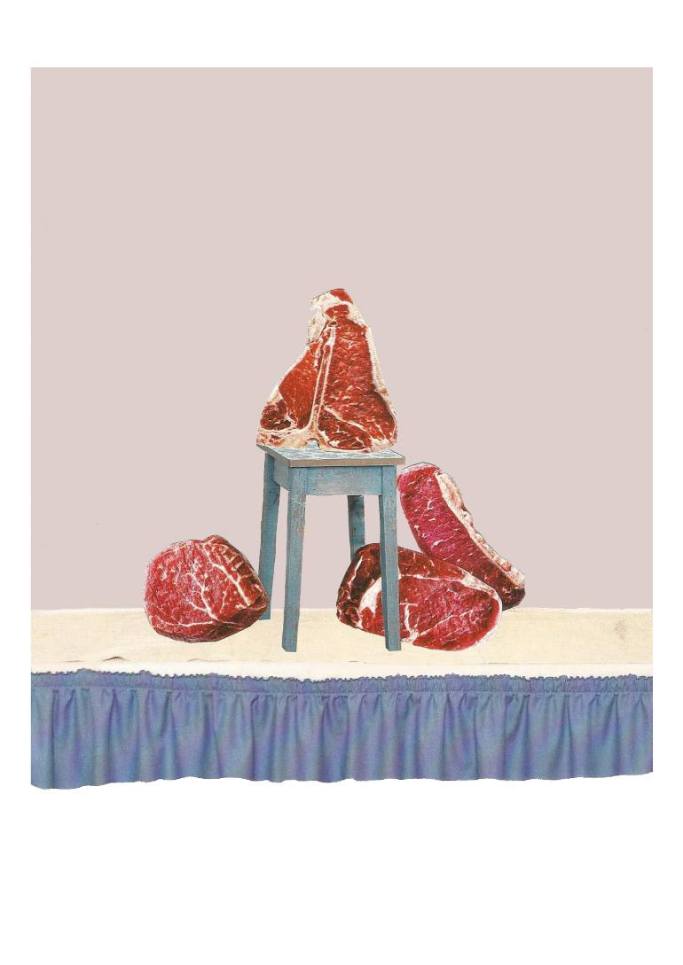
Vector on cardboard
References
Anon, Color Harmonies: complementary, analogous, triadic color schemes. Available at: http://www.tigercolor.com/color-lab/color-theory/color-harmonies.htm [Accessed November 1, 2017a].
Anon, Still Life. Available at: http://www.timetrips.co.uk/still_life_history.htm [Accessed November 28, 2017b].
Anon, 2012. THE TECHNIQUE. Impressionist Techniques. Available at: https://impressioniststech.wordpress.com/the-technique/ [Accessed November 27, 2017].
van Gogh, V., Vincent van Gogh Gallery. Vincent van Gogh Gallery. Available at: http://www.vangoghgallery.com [Accessed October 8, 2017].
Rekkali, Z., 2016. Old Masters at Koller: Art and Love, Still Life and Tulip Mania. Mearto. Available at: http://blog.mearto.com/2016/09/14/old-masters-at-koller-art-and-love-still-life-and-tulip-mania/ [Accessed November 28, 2017].
 Creative Arts