Observational Drawings
This exercise I intend to do twice; the first time in an impressionistic style, and the second time in a realist style. For the realistic style painting (which I have not yet begun), the observational drawing was most important. For the Impressionistic style painting (which I have completed), capturing accurate detail was not so vital.


Try as I may, I did not succeed in producing lovely fabric folds. Even with the understanding of varying shadows, temperatures, highlights, and reflected light; my sketches resemble broken bones.


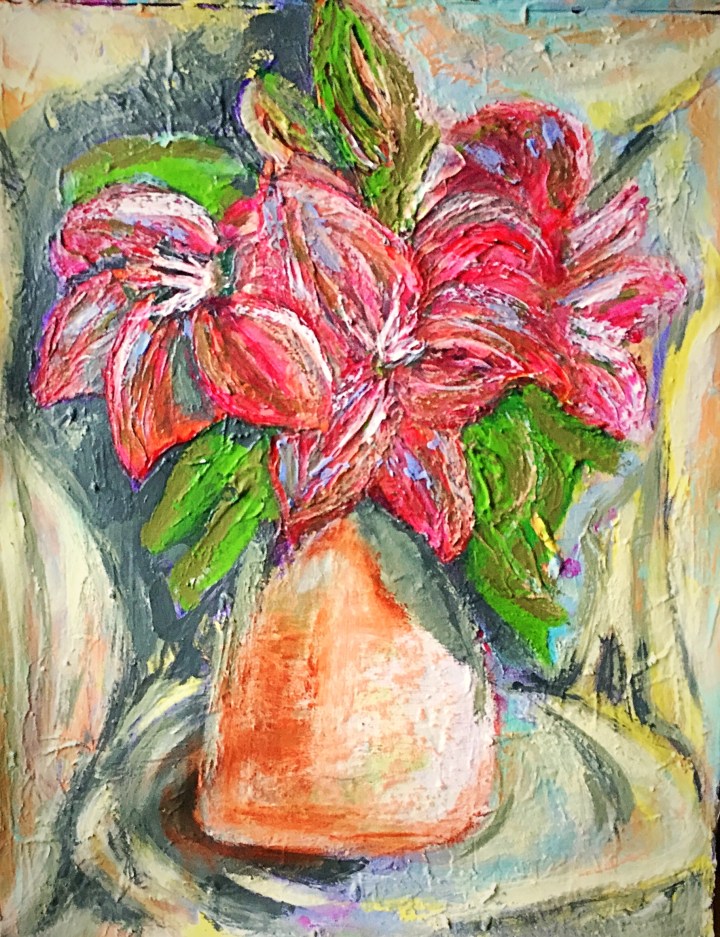
Still life with Flowers Painting, Impressionistic Style
Here I used impasto and broken colour in acrylics. I would prefer oils, but as this was my first try at knife painting; I thought it may be a waste. I appreciated the way form can be achieved without painting actual lines.
Complementary Colours
helped me achieve colour harmony and a more balanced appearance in my painting:
°In areas where my flowers seemed too red, I added green to tone them down.
°I dry brushed red over the green leaves, as they seemed detached from the rest
Of the picture.
°The vase which was initially blue was too cool but warmed
with the addition of orange.
°I added yellow to balance the intensity of purple.
°I used grey and white to make a more tonally graded painting.
Conclusion
This painting was a lot of “firsts” for me; first time regarding complimentary colours, broken colour, and impasto technique. I am eager to try this in oils, as I really don’t like the flat-plastic results I had here. I’ve seen fabulous examples of portrait paintings where highly pigmented colours were used in a colour block scheme. I’ve also seen acrylics look stunning in abstract art; it just has not yet happened for me.
 Creative Arts