Assignment three
Self-Portrait
This section was a few firsts for me; including handling oil paint and alkyds, figure studies, and rhythms. Before beginning this assignment I explored many different portrait artists. In addition to those suggested by my tutor, I also found paintings by Anna Bocek to be interesting, as she uses energetic colours and varies unblended brush strokes. Other portrait artists which impressed me with their strong tonal contrasts include; Lukasz Stoklosa, Kinga Nowak, Benjamin Shine, and Eugène Delacroix. One artist who surprised me is Emma Uber. Ms Uber paints entirely in pastel tones, using only accents of dark value. she distinguishes the subject from the background by changing the temperature, not the value. One Berliner who demonstrates amazing patience and technique with pooling oil paints is Mathew Davis. His paintings look like they are in constant motion. I’ve visited two different photography exhibitions to explore lighting and composition of portraits; which included works of Vivian Maier, as well as Edward Quinn. I’ve studied additionally figure painting in oil, tonal painting, foreground and background, and drawing the hands, heads and bodies, and both fluid and charcoal mark making (all which I will site in their proper categories). What I’ve learned most of all in this section, is how to view contemporary art and understand the context in which it was created.
For this assignment, I’ve decided to have zero background objects and focus only on the subject. I aimed for an energetic mood with a bit more likeness to myself than previous self-portraits.
Preliminary sketches
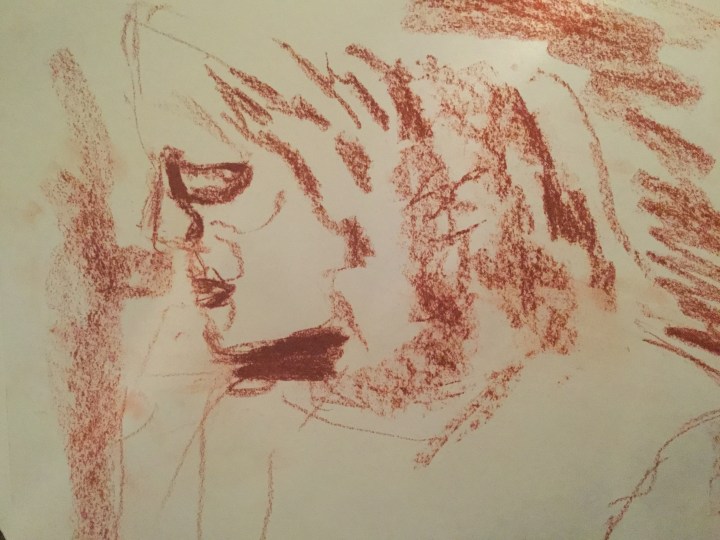
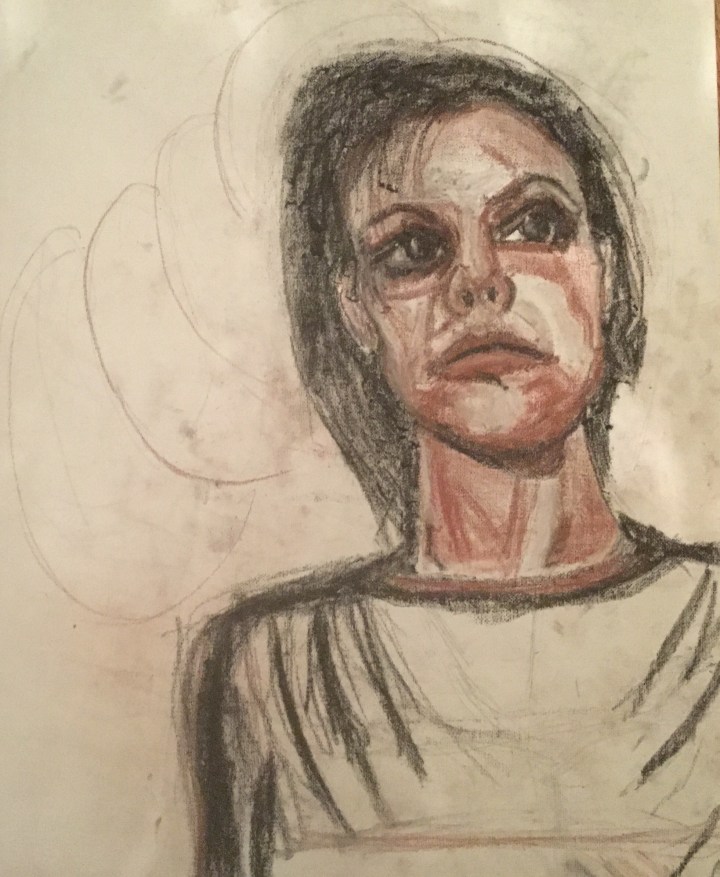
For the underpainting, I used acrylics and acrylic ink. I thinned them with retarder to slow the drying time to allow room for error. Once completely dry, I chose alkyd oils, because of their fast drying time. My colour palate consisted of pthaleo blue, Ultramarine blue, cerulean blue, Naples yellow, cadmium yellow, magenta, Pthaleo green, Payne’s grey, flake white, and one pigment called ‘flesh tint’. I worked out the key flesh tones by creating different values including mixtures of the pigment ‘flesh tint’, violet, Naples yellow, and pthaleo green.

Exercise telling a story, Pg. 96
For this exercise, I used all of my resources of colour, tone, shape and line to convey a narrative. I continued in the vibrant palette of the fauvists and only slightly outlined the main characters this time. I felt it may have been overdone in the conveying character exercise. As I know my tendency to add too many distracting details in the background, I began with a simple sketch. The narrative was only going to be “A Day at the Beach”.
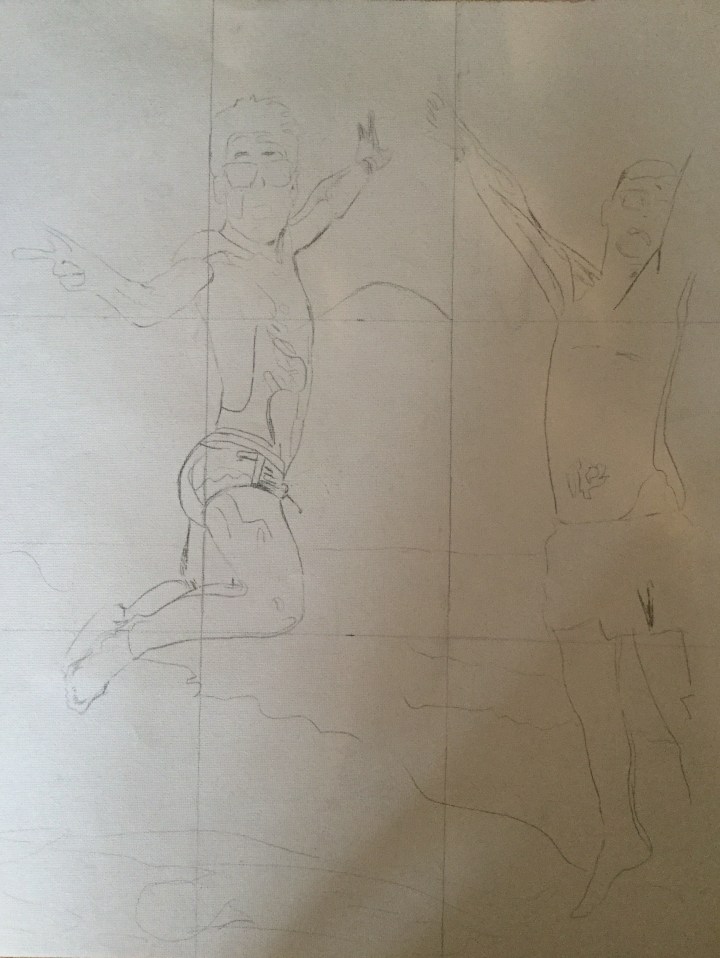
After I painted the main figures and seascape, I found it much too cliche’ and thought it would be improved by some hints of danger. I then painted over most of them, save a few. I decided that I wanted this to be more of a modern-day apocalyptic narrative, with two angels at the beach. I tried to keep the dangerous aspects to a few: A landmine warning sign in the corner, giant jellyfish, Japanese whaling boat, and an impression of Michelangelo’s God flying away showing his bum to all.
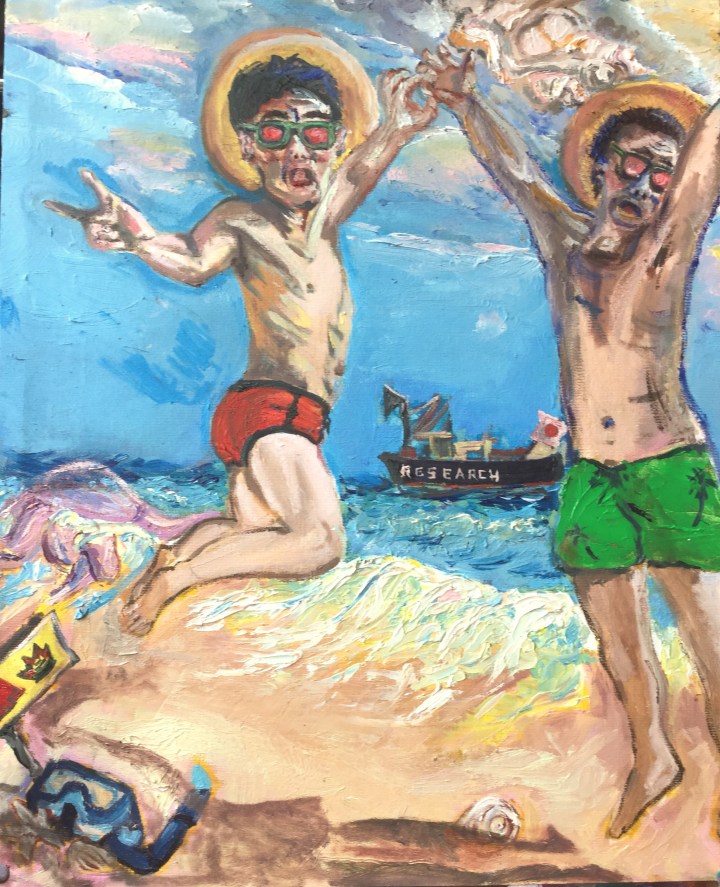
This time I felt the hands improved.
Exercise A figure in an interior
For this exercise, I wanted to achieve a lonely mood, with a subject in dark surroundings. This time my model was clothed and more comfortable, in his evening element. Because I wanted to experiment with broken brush strokes, rhythms, and impasto paint, I began this exercise earlier on. I’m glad I did so as the initial interior was too detailed and distracting from the subject. If I were to try this again, I would like to experiment with the Interior being more detailed and the figure being blurred (as in Alexander Kanevsky’s work).
I tried to stick to the fauvist palette to keep things vibrant.
Because he had fallen asleep, I didn’t feel like he would mind sitting one position for so long. I did eventually cover him with the blanket as it was rather chilly with the windows open.
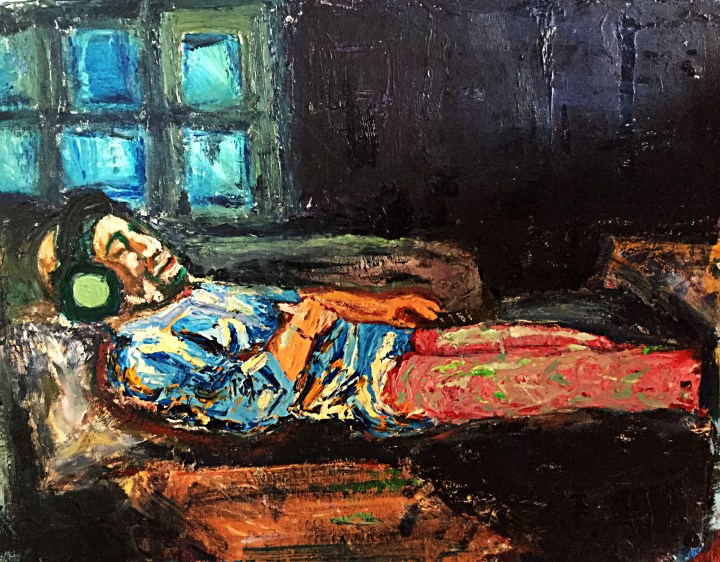
More than a few times, I had to scrape off paint and try again; especially in regards to the interior. This went on over a period of several days. The hands were the most challenging and somehow disproportionate to the rest of him. They resemble Muppet hands. I found it difficult to layer paint thickly and achieve detail, but it was fun. I also used much more paint than I anticipated with all of my oil paintings for this section. I’m aware that I can make some adjustments to improve this painting, but for now, I need to move on to the next assignment or I will never finish.
Exercise conveying character, Page 91
I was inspired by Marlene Dumas’s portrait of ‘The Widow’, and how she recorded a meaningful moment. I like the vibrant colour palette used by fauvist expressionists and decided to use it for this study and the remaining exercises of this coursework. I chose a photo which I’d like to give credit to which I feel captures a momentary expression, impossible to achieve in an all day sitting. Again I wanted to work more with background mark-making as well as experiment with colour. I aimed for a likeness, but not a realist version of the subjects in the photo.
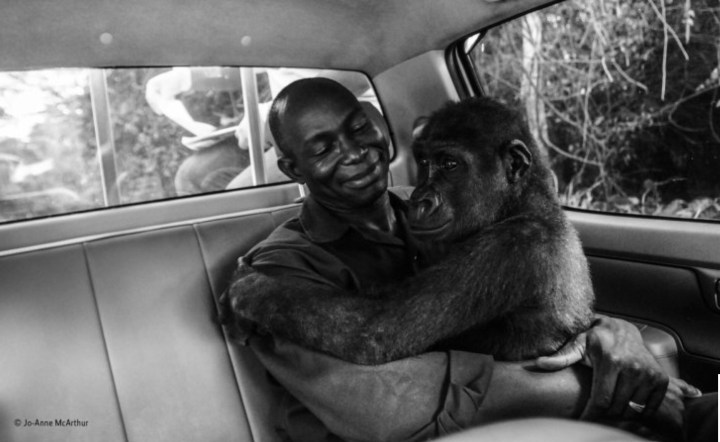
I did a light sketch in pencil and conte:
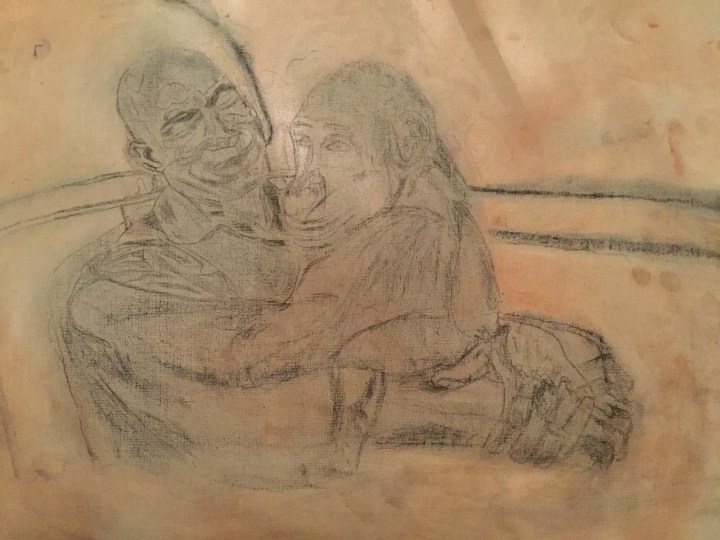
Then painted wet into wet using the fauvist palette:

When near the end, I outlined the figures in a dark value to distinguish them from the background.
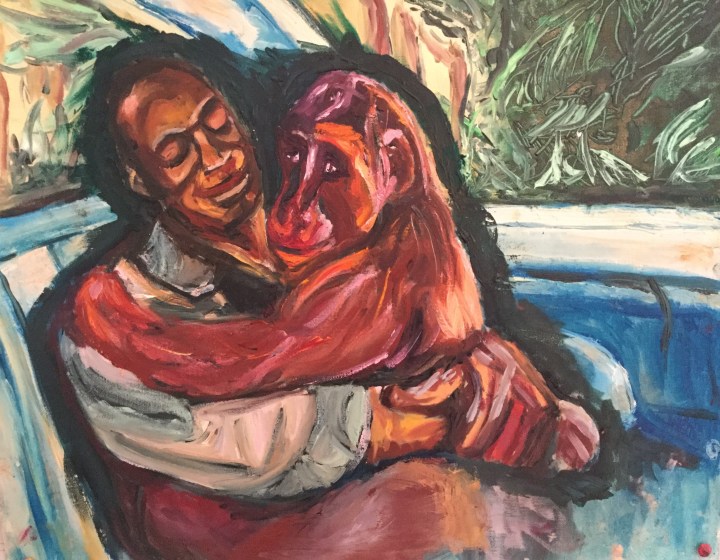
I found it a bit hard to interpret the expression on the man’s face as looks down at the gorilla. Technical issues I encountered with the handling of my paint were the strong fumes from the linseed oil. I had until everyone was in bed so that I could begin working with open windows. may open the windows. After reviewing all the portraits thus far, I found this one required the most time, yet was more successful in conveying what I wanted it too. Perhaps before I was more focused on conveying a mood or getting proportions right.
Exercise Creating mood and atmosphere, Pg. 90
For this study, I set out to achieve an energetic mood, and experiment with colour. I wasn’t attempting unusual likeness. I also wanted to practice more creating background with nondistracting marks and blurred lines.
Preliminary sketches using myself as the model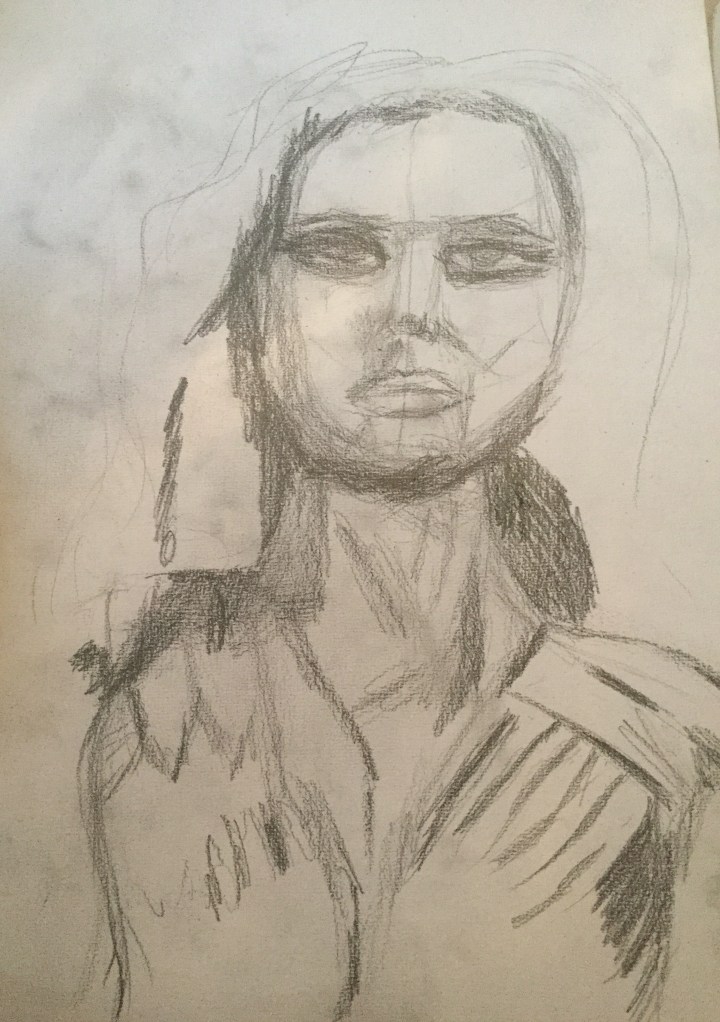
I prefered the second one to the first. I followed the same technique as in my self-portrait; a charcoal sketch with values, fixing, washing in Quinidine red acrylic ink. Unfortunately, I did al of this on the rough side of the canvas which had too much tooth. So I had to add a couple layers of clear gesso and allow drying time. I then rewashed. 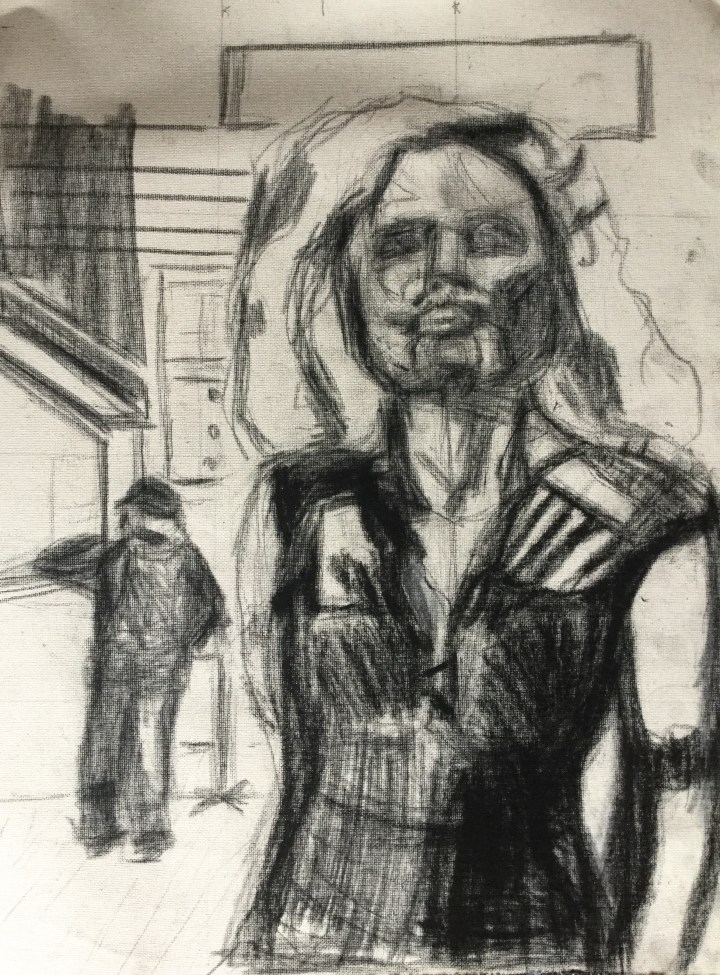
I pinted in the background plus negative shapes first. I outlined the figure in a dark value. Here I made the mistake of not allowing it to dry. I moved onto painting the darkest values and starting to add highlights. Because my initial lines had become obscured, I lost all the proportions of the figure. I then had to try to re-establish them later, but they were still gross abstractions. Because there was so much medium, the paint was not drying quick enough. I am just learning the handling of oil, now appreciate the “fat over lean” concept. I used an initial colour palette of permanent rose, Ultramarine blue, Pthaleo blue, Pthaleo green, Cadmium yellow, flake white and zink white.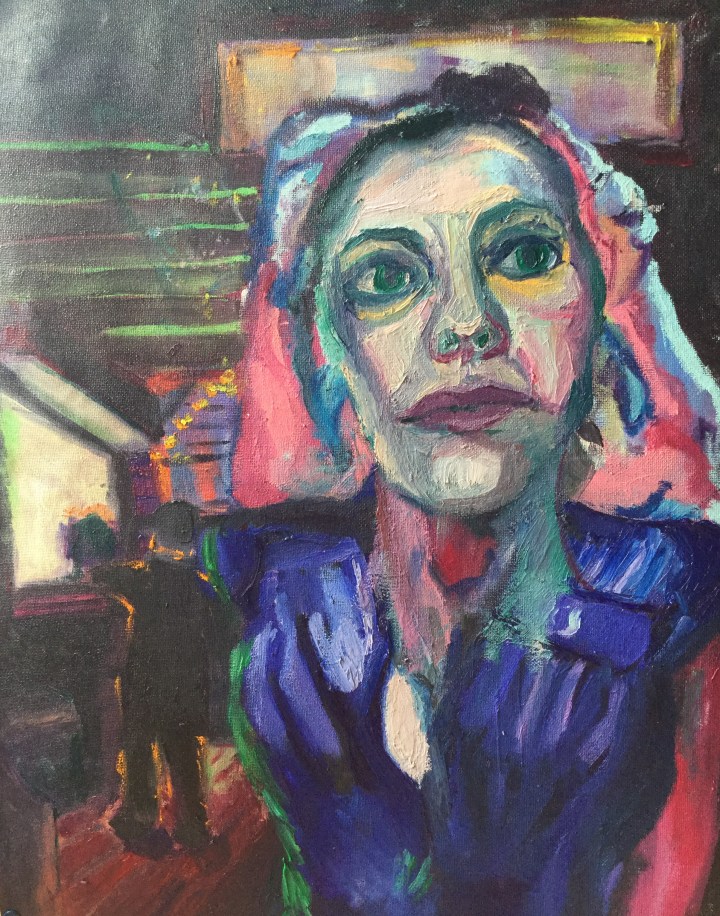
At this stage, I still am waiting for it to dry before I can make any more adjustments.
Exercise Self-Portrait, Pg. 87
This study I did after the head and shoulder of my model; as I needed to work around his schedule. I found this one particularly hard, perhaps because we all had the flu, and I couldn’t bear looking at myself. I felt a bit used and run around by my family as well. It was challenging adjusting mirrors and light. I used the reverse camera on my computer for the forward glance and a side mirror from the profile glance. Initially, I had natural light but later changed to one artificial light source.
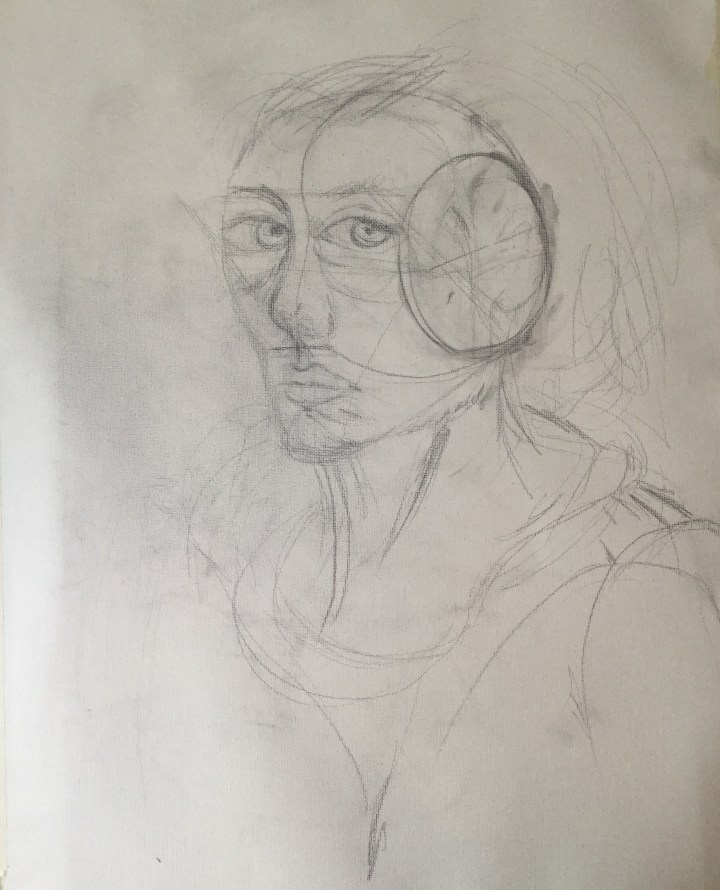
I did the initial outline in pencil, then added in values with charcoal. I sprayed fixative on the canvas. Once dried, I washed the sketch with quinidine red, Acrylic Ink. This alone gave me some great darker values and mid tones. I used a palette of yellow ochre, raw umber, burnt umber, cerulean blue, Cadmium green, flake white and titanium white and cadmium red. I tried to paint as little as possible. I felt the nose, chin and ear hardest to tackle; probably my attempts to repaint them made them grow awkwardly large. Then I had to readjust the size of the eyes to match.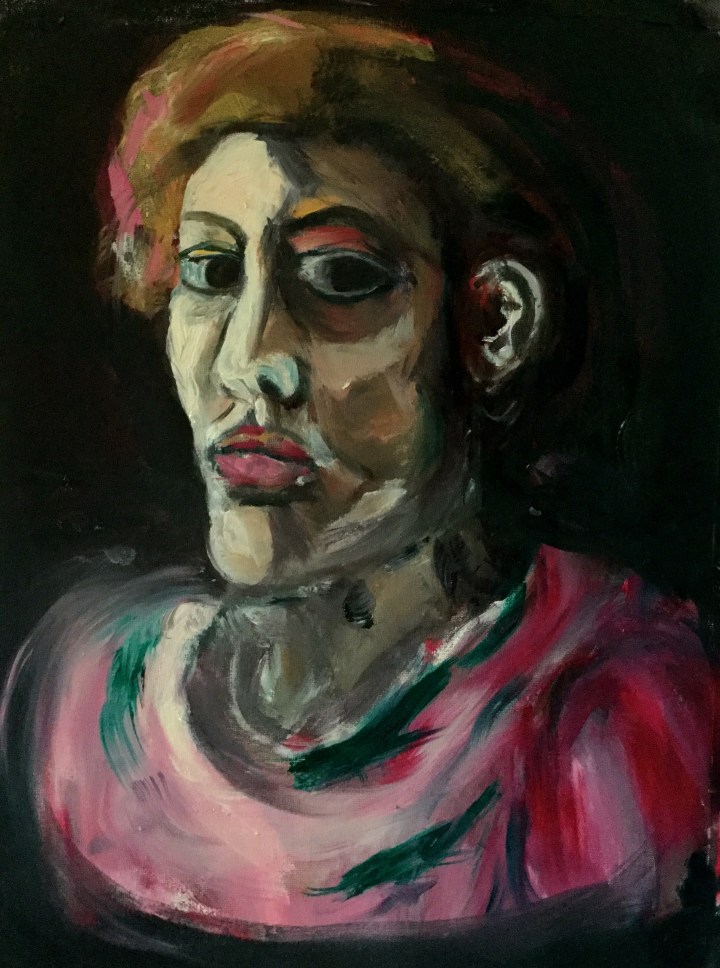
Does it have a likeness to me? More a likeness of how I was feeling. My husband says it has something, says she’s always watching him and he feels judged.
Exercise Tonal study figure, Pg. 84
This time I didn’t have the luxury of natural light and had to use artificial light sources. I wonder how it must have been for Rembrandt and Vermeer working by candlelight and how they were able to achieve such great tonal values without going blind.
In preparation for this painting, I repositioned my desk lamp several times to achieve the most dramatic effects. I first created a linear figure study with the same palette as the previous exercise.
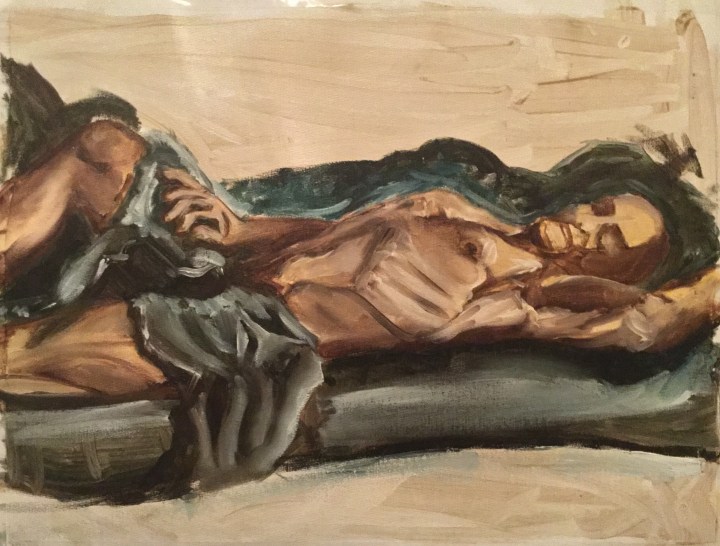
I created a grayscale and matched the values to those of my linear study. I added some gestural marks to help define his features. Unfortunately, I lost contrast when I applied the greys.
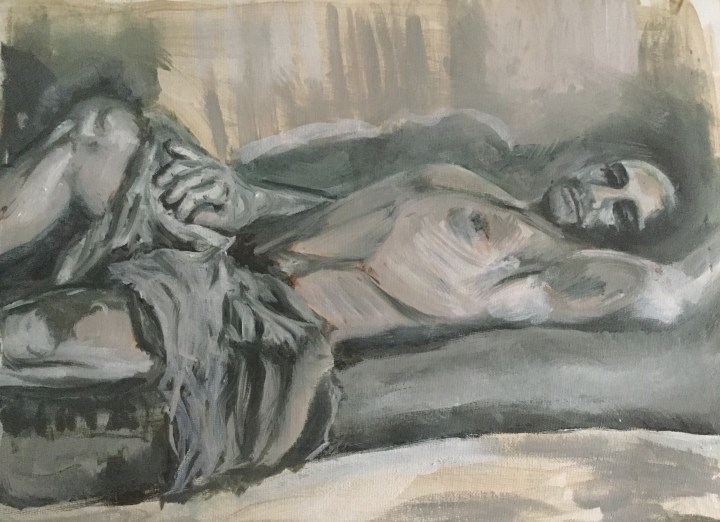
This where I feel a bit stuck. I began glazing, hoping to bring more contrast, and am now not sure how to continue. I’m sure it could be much better, but do not know how exactly how to improve it without damaging it further. I believe it has something to do with the balance of warm and cool.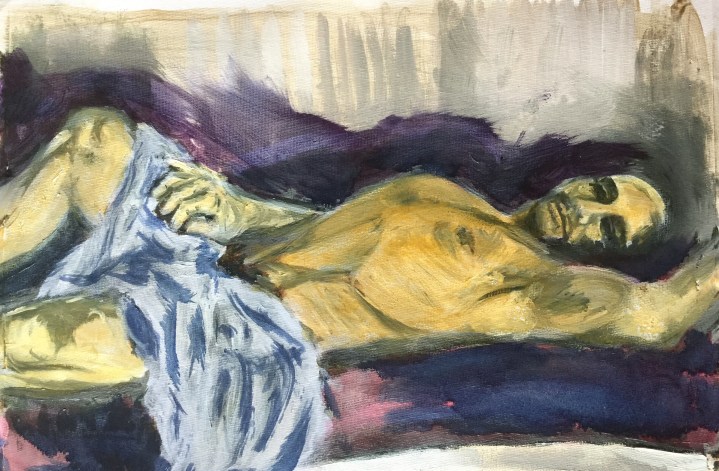
Exercise Linear figure study, Pg. 83
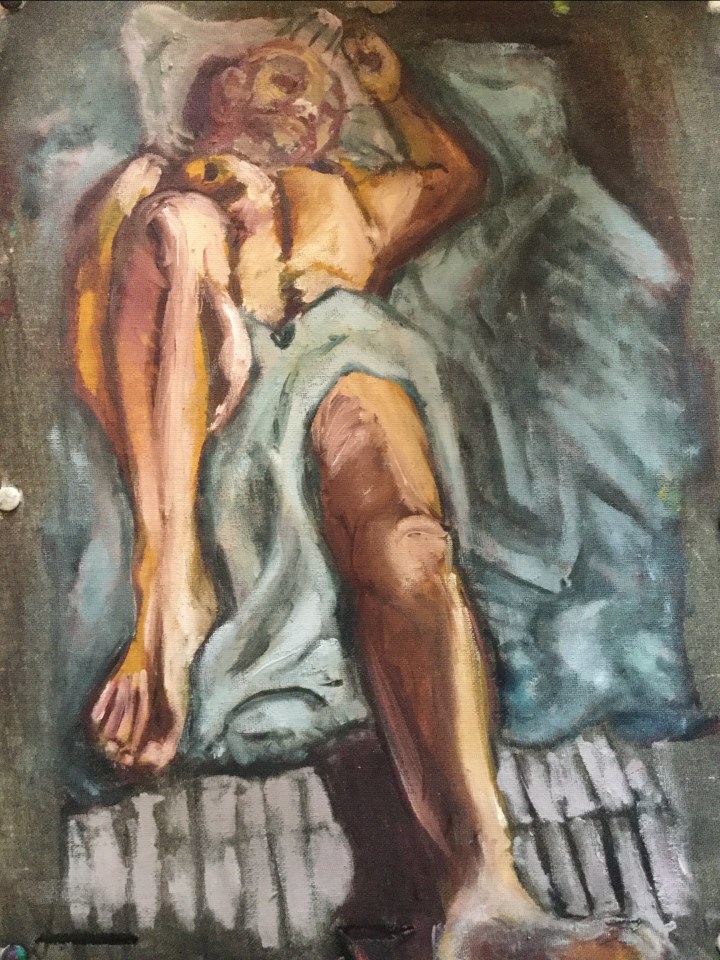
For this drawing in paint exercise, I used diluted raw umber to draw shapes of the figure. I added a touch of cobalt blue to the mixture and outlined the negative shapes. Once dried I applied a thin wash of sepia over the figure, and a thin wash of umber and cobalt blue with a touch of yellow, to the negative shapes.
Adding a bit of medium to slow the drying time, I blocked in the darkest shadows with umber. For the highlights on the subject, I used some of the initial wash of sepia with flake white. Because the paint was still wet, I was able to easily blend the shadows and highlights, creating more mid tones. For the outlining negative structures and shapes, I used a mix of the umber/ cobalt blue/ yellow wash with medium and flake white. I then blended them the darkest and lightest areas.
I did have issues with paint dripping as I worked on this. Eventually, I laid the canvas on a flat surface. I was fortunate enough to have good natural lighting that day. My model was quite uncomfortable on the hard floor. Because of his understandable shyness at being nude, I draped a blanket partially over him. I appreciate how patient he was with me. I found I already had great tonal values here without applying a grey scale.
Exercise Drawing the human figure, pg. 82
Observing the human figure through a series of sketches
I was able to use my reluctant husband as a model for observing the human figure. I repositioned him several times, which caused him great annoyance. He was uncomfortable with being nude, and the first two paintings reveal this. I used lightly pencilled in grids to get perspectives right and aid in foreshortening. I drew in equal boxes, before outlining him, to keep his body in proportion. Supporting structures, such as a bed, chair, couch and floor helped me assess his size in space. Because he didn’t have thirty-six hours to remain in a stagnant pose, I had to photograph his exact positions so that when time allowed, he could return to them for the subsequent paintings.


 Creative Arts