Figure studies, hands, and heads
As this is new to me, I realized quickly that I need some guidelines on portions and perspectives in drawings. The only book I found which really suited me, as it included many practical steps to practice was ‘Figure Drawing for All it’s Worth’ by Andrew Loomis. Here he demonstrates how to go from stick drawing in equal proportions in eight sections, drawing the outlines shapes in various perspectives, using spheres and cylinders to give a figure three dimensional form. He also emphasizes which lighting works and which doesn’t, which I found helpful in positioning my sitter or adjusting a lamp. I especially needed this book to understand foreshortening. I could not have drawn full figures without it. What did not work for me, simply because I did not have time for it, was the depth he delves into with musculature attachments. Though still, I find this valuable.
Mark making with pen and ink
I really enjoy fluid mark making, as it is portable and something I can carry supplies with me to exhibitions. I’ve recently purchased some ink brush pens which can be used with other fluid mediums as well. Bob Davies writes a blog entitled ‘Tips for Painting Line & Wash’ on a site I visit frequently called the Art Tutor. Here, he demonstrates pros and cons of different vehicles for mediums, as well as going from lines using a solid pen filling in your sketch with liquid ink (or watercolour). I found this helpful when buying products. I only wish he had posted some short videos of his process.
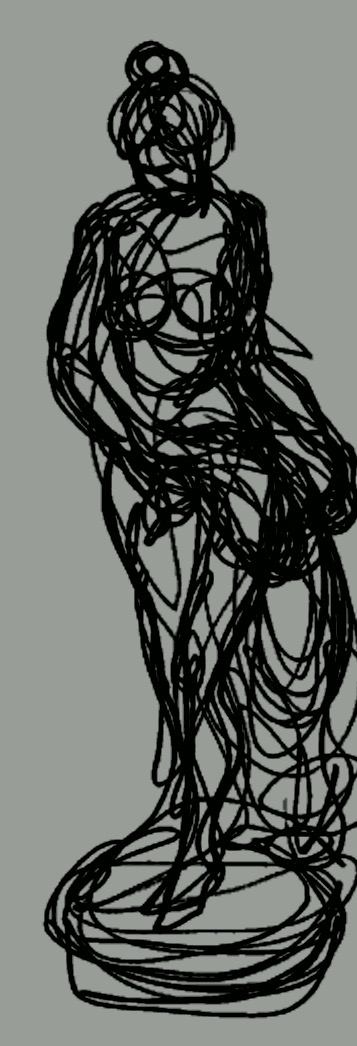
For additional ideas in mark making, I got tips from Greg Albert’s ‘The Art of Scribbling’. I found this to be a much more carefree style of drawing in which I was able to still achieve a resemblance of likeness to the form I was actually looking at. I liked it because it was much faster than trying to do a proper linear figure sketch; which I still cannot accomplish quickly. The scribbling technique he teaches is also a great way to capture motion. As the illustrator states “Everything has gesture.” Though it is not possible to capture facial features or expressions in small-scale scribbling.
Tonal studies
Because I had no idea what steps to follow when creating a tonal study, and my book collection so for does not cover this, I searched for guidance on the web. Luckily, Will Kemp has a five-part series on creating a black and white portrait from start to finish called ‘How to Paint a Portrait in Oil’. He explains each step and demonstrates his process. He covers everything from the initial drawing to explaining mediums in oil paint, and each pigment he chooses and why. He also gives you alternatives to use if you are missing any of his listed materials. What I didn’t like, as a beginning oil painter was creating a grey scale of 9 values. At the end of my portrait study of my sitter, I really could only discern four values, yet had wasted a lot of time applying them all. Another point is that he painted from a photograph of himself, as I had no photograph, but a real person, it would have been helpful to have seen more instruction from drawing with paint as opposed to sketching from a photograph.
My quest to understand Modern Art
‘This is Modern Art’ by Mathew Collings gave me a timeline of names and pictures to begin to explore the vast expanse of the modern art world. He listed key players from different nations, and what they contributed to the Modern Art movement. What I learned from Mr Collings; was the meaning of the myth of an artist, the various mediums beyond paint which carried the movement (film, print, radio, television, ready-made, minimal shapes, objects, humans sculptures), the value of ‘shock’. Because of Mr Collins, I re-discovered Jackson Pollock and Goya. I also learned that while Salvador Dali considered himself a modern artist, the ‘true’ modern artists did not. They found him too flamboyant and consumed with his own wealth and fame. I was shocked to learn that Picasso, whom I’d believed was the father of the modern art movement, was considered despicable by the others because his paintings were too concerned with beauty. Of course, the previous statements are all based on what Mr Collings has written, and in his writing, he constantly contradicts himself which I find completely annoying. While I do admire this book immensely, I despise the style in which it’s written. Apparently, he wants to make his on modern art statement by confusing the readers. He frequently starts a paragraph with a question, then fails to answer it. He starts on one topic and drifts into another. For all of us who truly are ADHD and trying desperately to assemble our own thoughts in a clear order and stay on only one track at a time, his attempt to pretend like he is also one of us when he clearly is not, is not only confusing but offensive. Perhaps it is meant to prove his point that ‘Nothing matters.’ I think he would understand my appreciation of his book, in a modern art context of course, if I urinated on it and sent it back to him.
One book which was essential in understanding ‘This is Modern Art’, was my ‘Oxford Dictionary of Art & Artists’ By Ian Chilvers. I believe these two books are inseparable. This book helped me answer the unanswered questions of Mr Collings. It provides a concise timeline of art eras and includes the various styles of art created in them. It also gives contextual references to world history, which is important for understanding each movement and why it began. It defines art terms I’d never heard of such as ‘Land’ or ‘Earth Art’. It covers more details than Wikipedia; such as the personal lives of artists (which help define their myths). The only downfall of this book is that it does not contain the elaborate visuals of the later book. It would need to be many volumes larger if it did.
How do I view and understand art?
Ossian Ward answers this question most clearly in his book titled ‘Ways of Looking’. I found this was my best read so far, as I could immediately apply what I learned from it in art research and exhibitions. He’s created a simple mnemonic device to help us understand the art which we are looking at Time Association Background Understand Look again Assessment. If you want a detailed explanation of how to apply TABULA, buy the book. He instructs us to go into an exhibition with an open mind, as a clean slate with no preconceived notions. He also emphasizes the importance of knowing the history, time frame, country and circumstances under which each piece is created, and details about the local factors of the artist who created it. Despite being an art critic himself, he advises not to listen to any of them or use their vocabulary in anyway. He also seems to support the smaller art galleries instead of the leaders in the art world. He made me feel unashamed and actually privileged to be starting from scratch. With a fresh point of view. I’m grateful this was on our reading list, and can’t find a thing about it that doesn’t work.
Exhibitions
In our neighbourhood, we are lucky enough to have a photography gallery called ‘Photo Bastei’. They hold exhibitions which change every few months and present the yearly Swiss Photo awards competition, which actually hosts work from photographers worldwide. Switzerland is pretty tiny. Since I’ve lived in Zürich they’ve expanded from a three wall garage (I kid you not), to know a three-story space; which even has a cafe, bar, live music and a rentable venue for parties. Most recently I visited the ‘Meister des 20. Jahrhundert. Der Andere Blick ‘ exhibition. It was a compilation of photos of the twentieth century, from another view. I was shocked at the variety of photographers they represented in their collection: most impressively of those was from artist August Sander, a German portrait and documentary photographer:
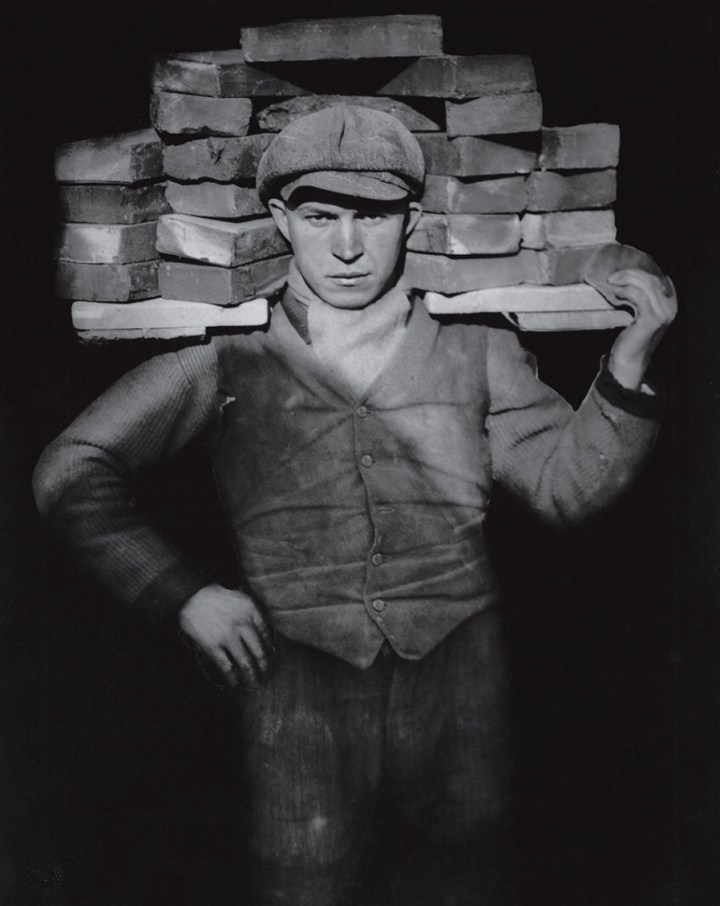
I was researching portraits to better understand composition, lighting and contrast. At first glance, I thought the subject very large and strong to carry all those bricks. Once I looked again, I realized he was actually of much smaller build and has rather small hands. It’s pride and dignity which make him seem grandiose. Though this man’s job was gritty and labour intensive, he is still wearing a button-down vest. It helped to research a bit about his home city of Cologne, and learn that this photo, was taken in 1928, it was taken during a three-year pause from both French and British Occupation until Nazi take over. Later, Cologne became the most heavily bombed city in Europe during WWII. Like other of Mr Sander’s photographs, this one is also taken directly, which gives his subjects a look of power and nobility, making their socio-economic class irrelevant.
The title of the exhibition is quite clever and lives up to its name’…another view’. Because I really needed three times to digest what I was seeing and understand it completely. The arrangements of the photos also debunked myths of the figures being photographed: For example, one wall of photos depicted Che Guevara in a heroic context, but at the end of the row was a photo of Ernest Hemingway and Fidel Castro laughing together, arm over shoulder. At first glance, I felt anger. By the third look, I understood what I was seeing, and in awe of the clever display.
What didn’t work for the exhibition? Well at the entrance there was no-one to greet you. You simply drop 12 CHF in a slotted box and then press the button on the tally counter. I worry that they may get ripped off. I also would have liked a little more explanation of the photos, but since there was no one about, I was happy to research on my own.
‘Taking the Long Way Home’ By Vivian Maier
An earlier exhibit of photographs I was privy to, were all taken by Vivian Maier, a New Yorker who collected rolls of film which she left abandoned in a storage unit she could no longer pay for. Sadly Ms Maier found herself homeless the last years of her life. The men who owned the storage unit discovered her enormous collections of film and later developed them. Ms Maier’s work touches me deeply, as she had the ability to catch truly human moments, that others take for granted. I wonder what her days were filled with, and how she must have observed and followed her subjects to catch these eye blinking instances. Below are few I examined:
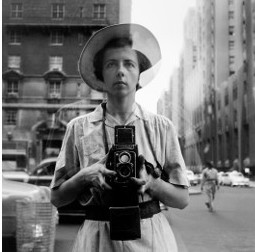
The subject below has such depth in her eyes. She seems to be lonely, waiting for a phone call.

She also captured children in their highest highs and tragic lows.
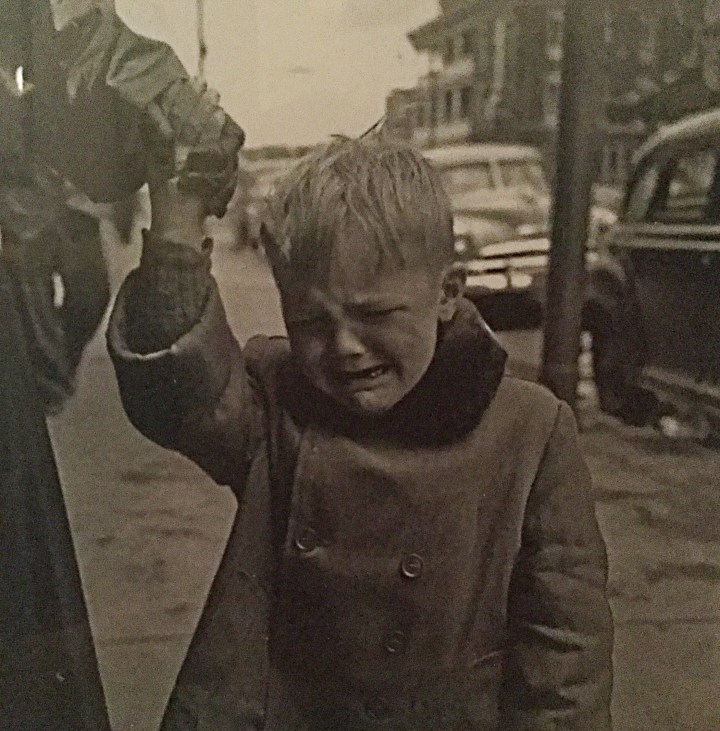
What I feel saddenned by, or what didn’t work for me, is that she was never realized. She seemed one who empathized so strongly with others, and had a truly unbiased lense. Yet no one was there for her, she died alone. You can buy work from this homeless artist who died alone on the streets to fill the pockets of some lucky SOB who probably doesn’t care in the least about her life except for their own financial gain on this website: http://www.vivianmaier.com/gallery/street-1/#slide-50
Or wait to see an exhibit in a local gallery.
References:
 Creative Arts