Self-Portrait
This section was a few firsts for me; including handling oil paint and alkyds, figure studies, and rhythms. Before beginning this assignment I explored many different portrait artists. In addition to those suggested by my tutor, I also found paintings by Anna Bocek to be interesting, as she uses energetic colours and varies unblended brush strokes. Other portrait artists which impressed me with their strong tonal contrasts include; Lukasz Stoklosa, Kinga Nowak, Benjamin Shine, and Eugène Delacroix. One artist who surprised me is Emma Uber. Ms Uber paints entirely in pastel tones, using only accents of dark value. she distinguishes the subject from the background by changing the temperature, not the value. One Berliner who demonstrates amazing patience and technique with pooling oil paints is Mathew Davis. His paintings look like they are in constant motion. I’ve visited two different photography exhibitions to explore lighting and composition of portraits; which included works of Vivian Maier, as well as Edward Quinn. I’ve studied additionally figure painting in oil, tonal painting, foreground and background, and drawing the hands, heads and bodies, and both fluid and charcoal mark making (all which I will site in their proper categories). What I’ve learned most of all in this section, is how to view contemporary art and understand the context in which it was created.
For this assignment, I’ve decided to have zero background objects and focus only on the subject. I aimed for an energetic mood with a bit more likeness to myself than previous self-portraits.
Preliminary sketches
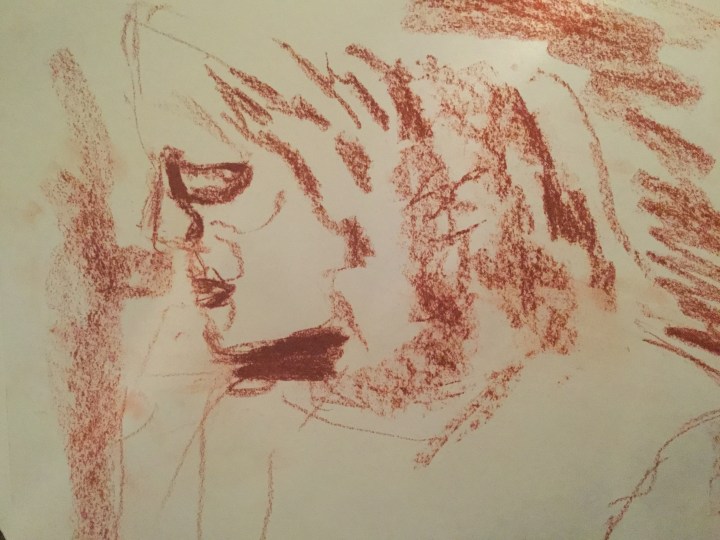
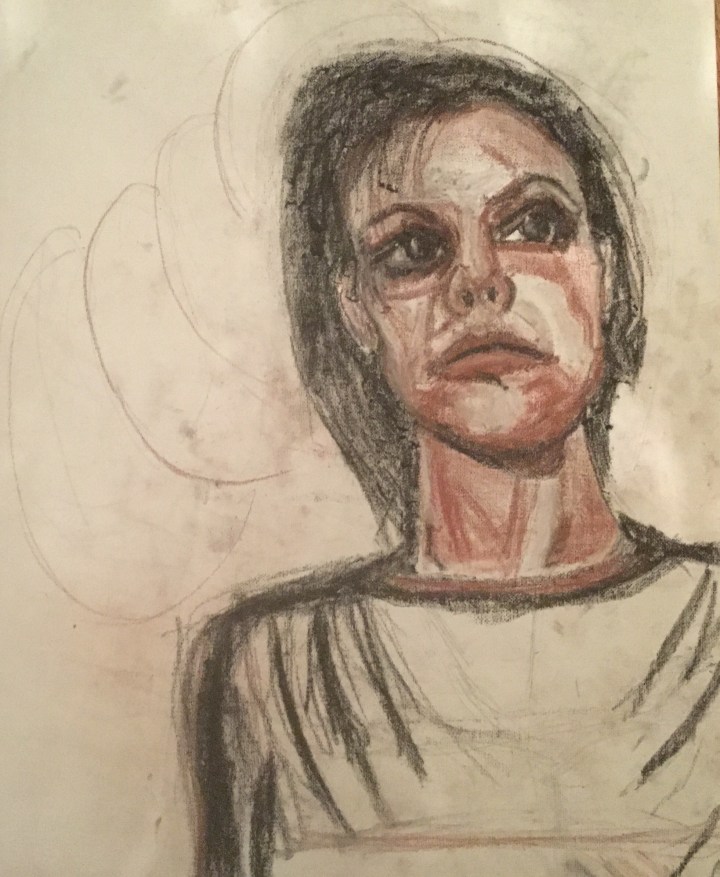
For the underpainting, I used acrylics and acrylic ink. I thinned them with retarder to slow the drying time to allow room for error. Once completely dry, I chose alkyd oils, because of their fast drying time. My colour palate consisted of pthaleo blue, Ultramarine blue, cerulean blue, Naples yellow, cadmium yellow, magenta, Pthaleo green, Payne’s grey, flake white, and one pigment called ‘flesh tint’. I worked out the key flesh tones by creating different values including mixtures of the pigment ‘flesh tint’, violet, Naples yellow, and pthaleo green.

 Creative Arts