Genre Painting
Scenes of everyday life, such as markets, domestic settings, interiors, parties, inn scenes, street scenes, and historical scenes. They may either be realistic or fantasized, but never idealistic.
Characteristics of Dutch realist genre paintings
°Linear perspective
A new way method of composition used as a way of creating the sensation of spatial depth, in which all diminishing parallel lines (called „orthogonals“) converge towards each other and meet at one point; the vanishing point.
°Naturalistic illumination
Brilliant pigments (usually 2 or 3) used to portray the intensity of incoming daylight.
°Pointillès
Dots of thick, light paint that represent specular highlights (areas with mirror-like shine which reflect light)
°Camera Obscura (hypothesised)
A concave viewing lens which reflects the subject onto canvas so the artist may paint/draw without having to move his eyes away from his hand. Often working in the confines of a small space, this would have been instrumental in composing one aspect at a time, with spatial accuracy.
Dutch realist genre painters
°Rembrandt Harmenszoon van Rijn (1606-1669)
Mainly a history and portrait painter, capturing mythological or historical figures in his work. His mediums were oil and printmaking by etching. His greatest abilities were to capture the effects of light and shadow, producing strong contrast to create lively and dramatic scenes.
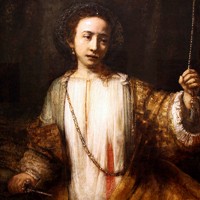
The above is a historical genre painting of a mythical figure. The subject’s face and body appear three-dimensional with the use of chiaroscuro. The lightness of her face and body seem to illuminate her virtuous and moral nature, while the dark manner of the atmosphere surrounding her enhances intense emotion in her expression.
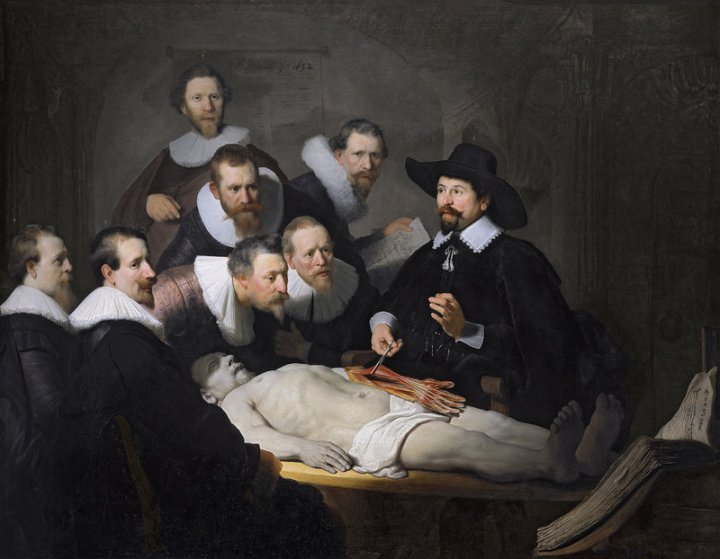
This is an actual scene that was a common public event in the 17th century, often taking place in theatres, used as lecture rooms. Those who attended paid an entrance fee and dressed as if going to play. The corpse is that of an executed criminal, hung that day. Rembrandt uses umbra mortis (shadow of death) here and in many other genre paintings. The viewer’s attention is drawn to Tulp, who demonstrates how the muscles of the arm are attached.
°Johannes Vermeer (1632-1675)
Worked primarily within the boundaries of a studio, and was devout on creating the illusion of three-dimensional space, rendering the effects of natural light.
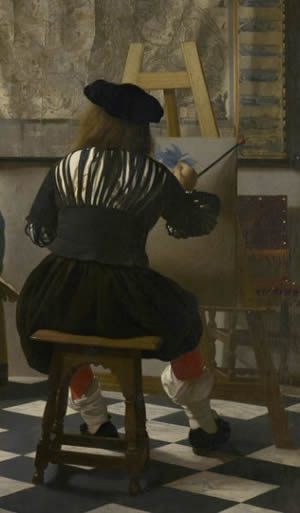
As in many of Vermeer’s interior paintings, such a this one; the viewer has the impression they are peering at a scene through an illusive door. Here there is an illusion created that a window permeating natural light exists, and illuminates the subject. The subjects back, feet and environment. This light draws the viewer’s attention more to the details of the room, rather than the action of the subject himself, which must be of lesser importance than the floor and the space in which his working. Perhaps this is to impress the viewer upon the relatively small spaces artist’s of this time were confined to. The light is also emanating from above and to the left; as if he were working from a lowly cellar space.
References
Anon, Genre Painting. Dutch Realism. Available at: http://342154211826700009.weebly.com/genre-painting.html [Accessed November 27, 2017a].
Anon, Suicide of Lucretia, Rembrandt: Analysis, Interpretation. Available at: http://www.visual-arts-cork.com/famous-paintings/suicide-of-lucretia.htm [Accessed November 27, 2017b].
Barbara, J., 2012. The Transcendent Technique of Etching, from Rembrandt to Nanoscience. Forbes. Available at: https://www.forbes.com/sites/julietbarbara/2012/09/20/the-transcendent-technique-of-etching-from-rembrandt-to-nanoscience/ [Accessed November 27, 2017].
Janson, J., Vermeer’s Painting Technique: A Five Part Study. Available at: http://www.essentialvermeer.com/technique/technique_overview.html#.WhwHuyydXfa [Accessed November 27, 2017].
Reference, Famous Genre Paintings by Rembrandt. Ranker. Available at: https://www.ranker.com/list/genre-painting-artworks-by-rembrandt/reference [Accessed November 27, 2017].
 Creative Arts