Figures in Interiors Twenty-First Century
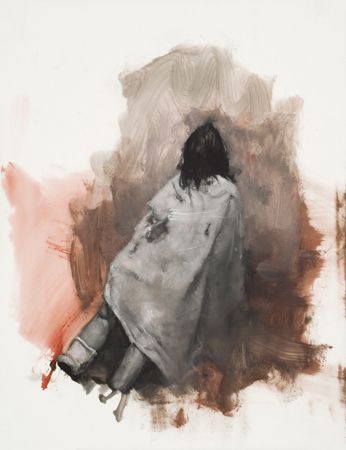
Sophie Jodoin explores themes of violence, highlighting the victims, not the predators. Here she uses minimal interior, that is implied, not seen; a chair propping the victim. Using a limited Palette, she achieves intense contrast between warm and cool, as well as between light and dark tonal values, makes this painting dynamic. Technically, I find it brave painting with oil on both mylar and paper as she does, and wonder how this is safely done. The features of the child are indistinguishable. This symbolizes anonymity to me, as her murderer has effectively dehumanized her. The blanket which covers her in a half-hazard manner serves to absorb blood, not as a gesture of respect. The killer must have been busy. As I can see so little of her body, I’m left to wonder what lies beneath the sheet. In later works by Ms Jodin, she eliminates colour completely, which creates profound shadow and depth.
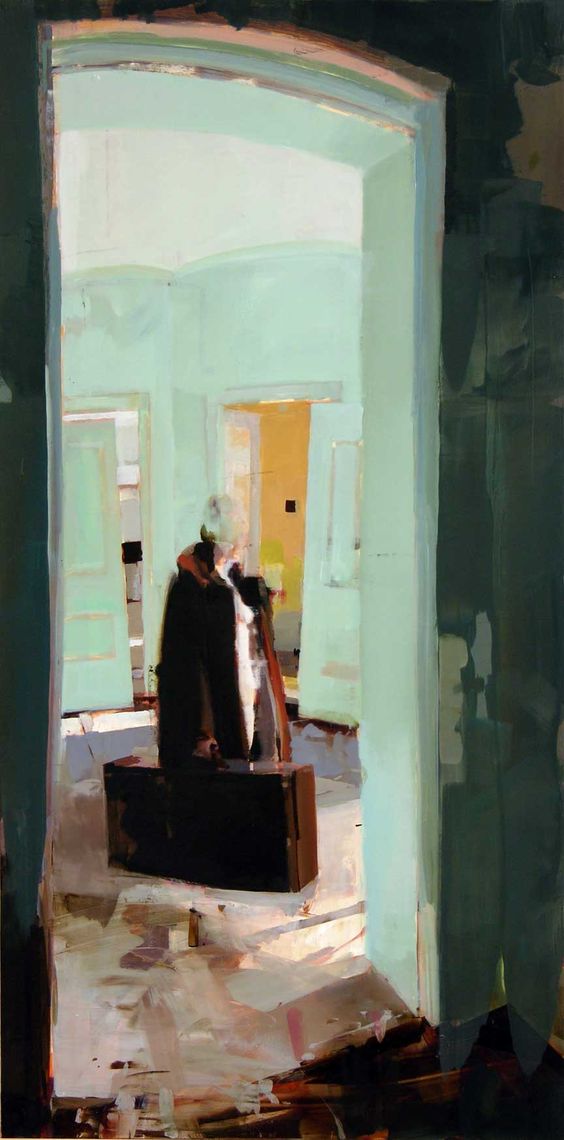
The following two paintings are by Alexander Kanevsky. He uses a technique of painting, rubbing out, and painting over. These multiple oil layers, which blurs the subjects of his paintings, also imply speed of time within stillness. He paints from life and photographs. Before he was solely an artist, he worked as an oncology surgeon. In his work, I see scenes of death and sadness. His paintings are often quite bright and energetic, despite the tale. In the painting below, he imploys rhythms of alternating warm and cool hues. The interiors are often clearly defined with strong lines, while the subjects are not. This solidness symbolizes the constancy of the surroundings, while the subjects are fleeting.
The piece below, I interpret as a story of a woman who is leaving a loved one behind. She is burdened with carrying a large suitcase of their belongings away. The person she lost, must have been in this hospital for quite some time. She’s moving slowly, without certainty. The dark room from which we see withness her, gives us the perspective of the recently departed, as well as the guilt they feel for the old woman’s grief.
The second piece (below) captures both speed and motion; the subject is moving faster than in the previous painting and with urgency. The mood is energetic. Mr Kanevsky uses rhythms of long sweeping brush strokes in translucent, light oil paint, alternating with shorter blobs of darker, intense chroma, opaque paint. In this scenario, I feel the emotion of the subject who is being left behind. Perhaps she is a ghost who has not realized her she’s passed on, or someone being confined in a mental institution. Both paintings have a unifying theme; the cleaving of relationships.

References:
 Creative Arts